Showing posts with label Economics. Show all posts

Saturday, March 17, 2018

Spring Break: Day 3-5

Day 3 and 4 of our project, Joy and I managed to fill in the cement cracks for 2/3 of the driveway - all I had prepared on Day 2. We were very pleased and surprised at how quickly we were able to fill the cracks. Joy poured the cement and I used the trowel to smooth it out. I think next time we have a free weekend we'll be able to fill in the rest of it and be done!

Joy got to spend her afternoon Thursday with Nicholeen Peck at the conference and she really loved the time. She even got to help her mentor at her booth and answer people's questions! She hopes she'll be able to help again next year. The kids and I had a nice time together, working, shopping, and preparing to leave.

Friday was a very busy day. We dropped Joy off at her conference and I took the kids to the Bureau of Engraving and Printing (aka the US Mint). We got to find out about how they make the currency. They've done a really nice job of it - informative, entertaining for my 6 and 10 year-olds. Sadly, however, they discourage bringing anything and everything into the building. Especially cellphones. So no pictures. The metal detector and guards are all at a second building a ways away from the main building (pictured), but they have two trams to carry you back and forth.

There's a nice little "people in your neighborhood" movie where the people who do the work talk about their jobs and how much they LOVE working at the BEP. The kids enjoyed some hands-on exhibits where you can zoom in on the money to detect flaws or see how the ink has shiny metallic bits in it. They had actual people to talk to who were very good with the kids and a self-paced audio tour where you saw the money actually being made. Real nice. The kids were impressed.

After lunch we went to the Kimbell Art Museum. Since Superstar completed his Cub Scout Bear that week, he is officially now a Webelos Scout and just HAPPENS to need to go to an art gallery! So he was very happy I was dragging him there.

This was my favorite painting - some Dutch 1600s landscape. I tend to rather like Dutch and Flemish painting from that era.

There were several places for kids of varying ages to make their own art. Princess and Superstar made fish collages. JT made a birthday wish and stamped it with a Chinese fan picture to hang on a tree.

We learned that Princess is particularly interested in sculptures. She and Superstar's favorite was a golden statue of the crowned Virgin Mary with baby Jesus. We talked for a while about comparing and contrasting two pictures of "some guy" - one in a slightly impressionistic style, one in cubist style. Princess posed with an Aztec god of spring and rejuvenation (below).

On our way out, I suddenly realized we had passed a Monet, so we went back to see the Monet Weeping Willow. The children were not impressed.


Mo' Monet, Mo' Problems

Friday, August 4, 2017

The importance of one inspired word: residual

In 2002 I was graduating from BYU. It was a great day and for the most part a very happy one. There was only one thing troubling me, a task I had not been able to accomplish. I had worked on it and done my dead-level best to fulfill it, but had not been able to. I worried about it (just a little) that day. Had I done right? Had I really done everything I could? Had I missed something important?

Our graduation speaker was Pres. Henry B. Eyring, an apostle of Jesus Christ. Most of his speech was about the school motto: Enter to Learn, Go Forth to Serve. He emphasized the second part, going forth to serve. It was a nice little graduation speech.

Then in the middle-end of his speech, he used a word that was very significant to me: residual. He told us to do the best we can, and leave the residual in God's hands. In econometrics - the statistics that economists use, and a class I had not only taken but TAd 3 times - the residual is an error term tacked onto the end of an equation for all the things we don't know and can't control.

I suddenly felt the beginnings of understanding a very important principle. Yes, we cannot know all that God has planned or control others' choices. We can only control what we can control. But we can trust God for all that we cannot control, that the end will bring us out alright, that even the greatest trials of our life can be for our experience and benefit. Trust Him for the rest.

That one word and that phrase stuck with me for the last 15 years. How important and what a relief it was to feel that I had done all I could and it was okay to leave the residual in God's hands! I went away comforted and at peace.

I was thinking of that experience again last week for some reason and looked up Pres. Eyring's speech. It turns out he only used the word residual once - enough for me to latch onto it - and otherwise used the term "residue." Maybe my hearing wasn't 20/20 even then and I heard residual because I'd spent so much time thinking about it. Here is what he said after quoting D&C 103:35-40:
Your key and mine to rising to our potential as servants is to know our Master, to do for Him what we can, and be content to leave the residue in His hands. Let me give you an example that will face you in the days ahead. You will be torn between the demands to put bread on the table and a roof over your head, to take care of a family need, to respond to the cries of the widows or the orphans around you, and at the same time to meet the requirements of the calling you have accepted in the Church. When that happens, you will be sorely tempted to murmur, perhaps even to complain. 
But remember that you serve a Master who loves you, who knows you, and who is all-powerful. He has created not demands for your service but opportunities for your growth. You can pray to Him with confidence and ask, “What would you have me do next?” If you listen humbly and with faith, you will feel an answer. And you will, if you are wise and good, set about to do that which your Master has commanded. And you will leave the residue in His hands. As His servant I promise you that you will find that some of those residual tasks you left will be done when you return to them. Others will have been prepared for you. And you will be the stronger for the task you already tackled. 
Then, when you pray again, an answer will come again. And you will move on to the next task, at peace and not complaining. Sometimes you may not feel an answer to your prayer because your Master may not care which task you start next. But He will care that you asked. And whatever you choose to do next, you will know that the residue is in His hands.

Thursday, February 20, 2014

A conversation with Hugh Nibley about my answer key

I was writing an answer key for my International Finance class just now. In passing, I mentioned an "Edenic business climate." That's when the imaginary ghost of Hugh Nibley walked into my office and took a seat.

Hugh: That is a contradiction in terms. There is no business in Eden, so there cannot be an Edenic business climate.

DW: Alright, fine. I'll call it idyllic then.

Hugh: Idyllic for Bablyon?

DW: Listen, Hugh, I'm trying to write an answer key here, and I'm not teaching a religion class.

Hugh: Why not? Shouldn't you be preparing them for the real world?

DW: I'm not being paid to teach religion. I'm being paid to teach about that part of the real world that deals with international finance and that means talking about business.

Hugh: 'Business! Mankind was my business. The common welfare was my business: charity, mercy, forbearance, benevolence, were all my business. The dealings of [international finance] were but a drop of water in the comprehensive ocean of my business!' Do your idyllic business conditions improve those?

DW: Thank you, Charles Dickens. Look, I do the best I can to bring ethics into my teaching. I have students consider the impact of these policies on the poor; I continually challenge them to "rove beyond the narrow limits of their money changing holes" to serve their fellow Nigerians; every semester at least one class gets to see me tearing money into shreds to convince them that money is not the point and never has been; according to their answers on the midterm, I seem to have convinced my principles of macro students that their businesses will be best served by paying their workers more; 

Hugh: Which you weren't trying to do...

DW: I'll take it anyway. I gave a mini-lecture just last week on Christian and Islamic finance. I do what I can. It's hard being an economist and a preacher at the same time.

Hugh: You mean it's hard to have one foot in Babylon and one in Zion at the same time? Some day you're going to have to choose.

DW: That's not a fair description of me and you know it.

Well, either he gave in at that point or else I had successfully fought against the light long enough to go back to the darkness of mere economics. 

And idyllic business climates.

Sunday, September 29, 2013

Finding common ground: Karl Marx

This semester I'm teaching an independent study course on "heterodox economics" - which is to say, the stuff that doesn't typically make it to the textbooks. I was pretty confident in picking the readings for the sections on Austrian and new institutional economics, but decided to chat with my next-door colleague, an avowed Marxist, to see what he would suggest for covering Marxism. He recommended the first volume of Das Kapital in the gleeful knowledge that he was getting ME to read it as well. He knew I was not about to assign something to my student I hadn't read myself and the recommendation is a sensible one since I'm assigning very sympathetic readings for the other topics as well. I've been meaning to read Smith, Keynes, Ricardo, Marx, et al "someday" anyway, so I took this as a chance to cross one off my list.

Primarily, I confess, I was reading so I could voice better objections to Marx than that I don't like his conclusions or rehashing other people's criticisms. I've found those objections and I'm quite pleased with the understanding I've gained in the last couple weeks. My opposition to Marxism is now founded on firmer grounds*. I also found two things that I liked.


The first was a lovely quote in praise of the labor market as
"a very Eden of the innate rights of man. It is the exclusive realm of Freedom, Equality, Property and Bentham [the greatest happiness for the greatest number]. ... And precisely for that reason ... under the auspices of an all-cunning providence, they all work together to their mutual advantage, for the common weal, and in the common interest."
I found myself in ready agreement with that characterisation.

The other idea was one I had never before considered, but I found it profound in my circumstances.

Sunday, August 25, 2013

Development in Yola

Shortly before we left for the summer I stopped by our preferred expat retailer, Luka, for some shopping. It looked a lot like it had when I was deciding whether or not to move to Nigeria.

On returning this Friday, however, I noticed that some of the stuff had moved around and there was a little more room. I didn't remember the ceiling fans, but they might have been there before*. The deep freezer on the side had been replaced by a tall fridge. The drinks had moved from an awning outside to a whole other shop across the street. Wow, I thought, Luka's been expanding.

Much more interestingly, the counter had completely changed. This entire time, Luka has had 2-3 guys behind the counter, adding up prices on large calculators, showing us the total, and (maybe) writing up a quick receipt that we paid x000 naira.

Luka's got computers. Not computer. Computers. Three of em. They aren't cast off, rejected from US elementary school computers either. They're running Windows 8 on flat screen monitors that print out itemized receipts with prices and everything. They scanned the items.

It was wild.

And our family was a small part of bringing that progress to pass. How cool is that!

Meanwhile, our preferred fruit and veggie dealer has added a lot of awnings to his business, upgraded the wood frame, and it seemed to me was dressed a deal better than when I last saw him.

Wednesday, May 8, 2013

A Neoimperialist reading of The Cat in the Hat

I was reading The Cat in the Hat to Superstar tonight. As usual, I like to pick random dialects, accents, and characterizations to make the books more interesting. Tonight I happened to give the cat a very deep, posh British dialect and the fish an Indian accent.

Suddenly the entire book was transformed into a colonial pseudo-commentary: wise India continually cried for the British to stop with their Great Game to play, but its voice went unheeded. When the British finally left, everything was a mess. But, in good neoimperialist/White Savior/white guilt tradition, the Cat shows up again as an NGO (or an economics professor?) to clean up the entire mess and restore everything to its idyllic state. Shall we go so far as to name Thing 1 and Thing 2 the Breton Woods Institutions of the World Bank and IMF?

Even though the narrator is "Sally and I" (notice the ever  dominant male perspective and the completely silent female), the real star of the show is the imperialist who gets his own line of dolls, t-shirts, books, sequels, television specials, and movies, all upheld by copyrights promulgated by Thing 3 (the WTO) and the corporatist government (the mother) who pretends to see nothing amiss. The neoliberal market allows the developed world to exploit the developing once again by controlling how its story is portrayed.

Thursday, May 24, 2012

A comment on the economics of Harry Potter

And, oh yes, we're back in CA safe and sound, happy to be well-fed on fresh fruits, vegetables, and Mexican seasonings, and well-rested but on East Coast time.

For some reason this early morning, I was pondering on the holes in the Harry Potter series, specifically the economics holes.  This is all very nit-picky as most fantasy/sci-fi authors ignore or try to wave away economics (replicators destroy money, replaced by gold pressed latinum, anyone?). But it is instructive of the kinds of things we forget markets provide for us. Today's installment: the markets for education and food.

1) The only ways Rowling deals with class are to have tension between an aristocracy and everyone else (mostly Malfoys and their aristocratic henchmen ... say what?) and a downtrodden caste (little green elves). So here's my question: why do the Malfoys send their kids to a school that is affordable by people like the Weasleys? Britain has a long and venerable tradition of "public" schools that are really private, so it's a surprising oversight to me. There is no mention of the tuition fees at Hogwarts, room and board fees which are quite substantial at British boarding schools, scholarships (why does Ron never worry about maintaining a high-enough GPA given his study habits?) and so forth. If the students aren't paying, where does Hogwarts get its money? If the school is totally public, the Ministry ought to be able to exercise a lot more control than it seems to.

2) Where does the food come from? Elves can't magic it up. Mrs. Weasley doesn't create food, but has a potato peeling spell. Are the wizards buying food from Muggles? If they are regularly buying goods and services from Muggles, why do they have truly no concept about their culture, ways, technology, and fashion? If not, where are the wizard farmers who grow food instead of reagents? Speaking of which, where is the foodie movement, arguing that non-magically modified organisms simply taste better and are healthier for you? I've always wondered in general why they never teach the potato peeling spell at school - where are home economics, barbering (how to not cut yourself with magically-propelled scissors, how to get your hair to change the exact shade you want, etc), wizard fashions, and other useful and applied classes that would help them function in the world without needing to deal with Muggle markets?

Monday, May 21, 2012

Things that count (aka 1st world problems in 3rd world countries)

I'm paid in US dollars. This is very nice because I don't have to worry about my 3-year contract eroding 35% or more during its course.

The problem is when I want to exchange dollars for naira (NIGH-ra). I go to the bank and hand them $2000, let's say, and then I need to stand around counting out 310-320 thousand naira bills because the exchange rate stays between 155 and 160 per dollar. I'm not nearly as confident and rapid a counter as the locals, so it takes a while and I invariably make mistakes and have to recount. If they hand me a wad of 500-naira bills, it takes twice as long.

I have more than once wished they would print a N5,000 ($30) or N10,000 ($60) bill to speed the counting process along. Imagine trying to get along for a year with nothing larger than a $5 bill and ALL your financial transactions are in cash.

Then I think better of it. Most of the time, I go to buy bananas from a street vendor and the chap has to wander around to all the other nearby vendors finding change. Because I only have thousand naira bills and can't hand him anything closer to N300, they invariably have trouble making change. I think of the challenge of asking someone to break a 10k naira bill....

Yeah, no. More than half the population doesn't even earn N10k per month. Imagine someone asking you to make change for one month's salary! Oh, the idle and unthinking rich. Wo unto us.

Friday, February 17, 2012

Shuffling the cards at AUN

I was sitting very comfortably, going from 5 classes and 4 preps* last semester down to 3 classes and 2 preps. I have been told by non-economists with more teaching experience that last semester was yoeman's work. I was ready for some sanity and some research time. I did (and do) feel sorry for my colleagues who had more classes to make that happen. But for the most part, I was looking forward to a much easier semester.

For about two weeks.

In order to accommodate Economist #7's arrival mid-semester (this week!) I traded one of my repeated classes for a new class: Game Theory.

I am very much of three minds about of this.

Sunday, September 18, 2011

Prince has something to share

"Daddy, I Love oatmeal. Tell the people I love oatmeal."

... Tell what people?

"Tell the people at work that I love oatmeal. And cookies. I love oatmeal and I love cookies."

Maybe someday you'll like oatmeal cookies!

"... I do not think I like That. I don't want that. So just tell the people at work I love oatmeal."

I got permission to use Prince as one of my first examples in my microeconomics courses, making decisions between buying peanut butter and pears. So he knew that I regularly talked about him at work.

Friday, August 26, 2011

Food Prices in Yola

Right now, the official exchange rate between Naira (Neye-rah) and US Dollars is around 150, and that is the number I'm going to use to translate prices here. I have been mildly surprised to find remarkably steady prices (over a 3 week period, granted) when I buy things from different vendors who will haggle. 

6-7 oranges is $1.33 in the modern market and outside of the expat stores and from some random vendor along the roadside.
A loaf of bread is $1.10 with anyone I've talked to. I forget what oranges cost in the US, but that's less than half the price of a loaf of bread, and it's really good bread. It holds up well, it's soft, it's sweet [Joy does not always appreciate that sweetness], and often it's a bit larger than what they offer in the States.
Half a watermelon is $2.67. A rather small cabbage is $0.67; a more normal one is $1.00.

Then there are the items in the expat stores:
A small jar of peanut butter (Skippy) is $3.33, a touch expensive, but a large jar is a shocking $12.
Cans of peaches or pears are $2 each. These two foods are Prince's staples at the moment, so we're very familiar with the price.
Given we're in an area with a high percentage of Muslims, pork products are not widely to be found. A tin of ham costs $4.67. You can also find Spam, but I don't remember the price off the top.
Tuna fish is either $1.33 or $2 depending on the can's brand.
Corned beef is $3.33 or $6 depending on the can's brand.
That, of course, is not counting the box of expired instant mashed potatoes for $8.
Thai rice (110 pound bag) at $0.50/pound
We were worried we would have no cheese, but the first day I found an enormous block of slightly sharp cheddar for a mere $56.

Wednesday, August 24, 2011

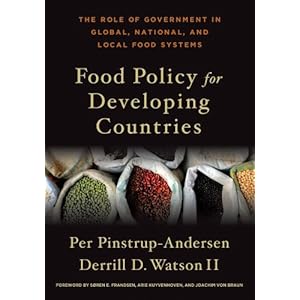
Food Policy for Developing Countries


I just got my advance copy of my textbook with Per Pinstrup-Andersen. Happy birthday to me! I am exceptionally excited to see this final, polished, beautiful book in my hands. I am also thrilled with the early praise:

"Food Policy for Developing Countries is a comprehensive and deeply insightful guide that will be of great practical value to policymakers, analysts, and students of food policy. It is a worthy capstone contribution that reflects the wealth of knowledge built up over the senior author's long and eminent career, and it should serve as the seminal work on this topic for years to come." -- Benjamin Senauer, University of Minnesota, coauthor of Ending Hunger in Our Lifetime: Food Security and Globalization

"Per Pinstrup-Andersen and Derrill D. Watson II serve up a rich multidisciplinary diet of insights into the incidence, causes, and cures for hunger in developing countries. The exceptional insights dished out by these authors known for their long practical and scholarly experience needs to be savored and digested by every student of food policy for the poor." -- Luther Tweeten, Emeritus Chaired Professor, The Ohio State University

"Per Pinstrup-Andersen and Derrill D. Watson II give us a comprehensive road map for understanding how governments and markets are shaping food outcomes in the developing world. The book provides food policy analysts with a sound political-economy foundation, international data on everything from sustainable farming to consumer food safety, and a complete set of recent and vivid stakeholder-based case studies. I have used the case studies to great advantage in my own classroom. At a moment when interest in global food policy is peaking, this is the book to read." -- Robert Paarlberg, Harvard Kennedy School of Government

Amazon tells me the book is scheduled for release there by Nov 24. Copies will be in the Cornell Bookstore well before that for this semester, though. I know that Cornell University Press is also trying to get interested faculty at other institutions textbooks as quickly as possible.

Saturday, July 2, 2011

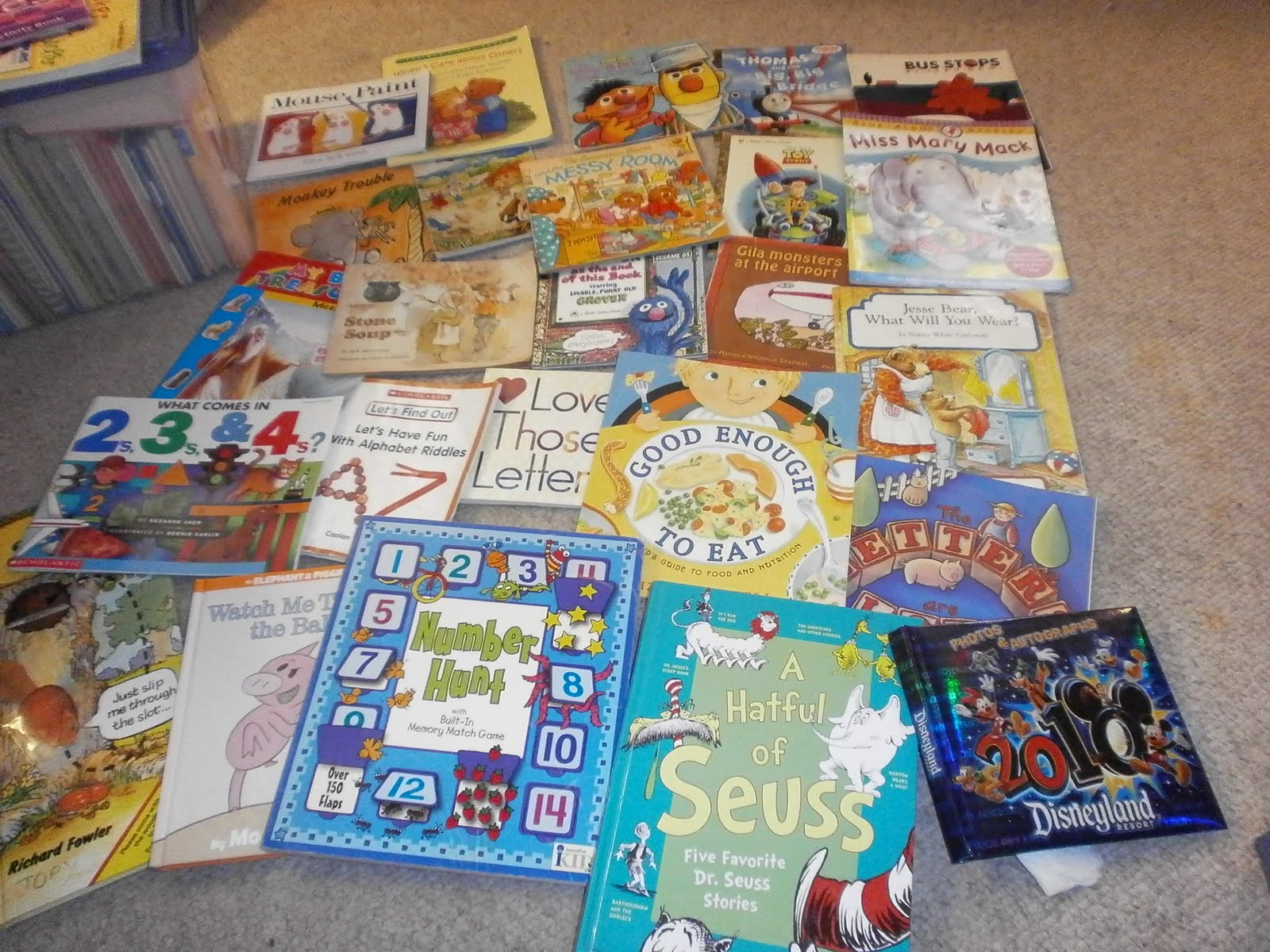
Prince's Books

These are the books Prince is carrying with him to Nigeria. The rest are being shipped. It took us most of the morning to go through the books. I went through each book and asked "Ship or carry?" and he answered his first 20 books "carry." After that, he had to trade me a book he had already chosen for another book. It took some doing, but we're pretty happy and think his final choices reflect his true interests.

By comparison, when I realized we had another stack of hardback books he had to go through and I had him make pairwise choices, every choice was to get rid of his last choice and take the new book. That was ridiculous. He ended up with a book he hasn't asked for in a long time. So instead we presented him that book and 4 others we knew he liked and he chose one of the others.

As an economist, this was interesting. How to reveal true preferences and a test of toddler rationality. His preferences expressed the first way were quite rational. The second way, not so much: he prefers The Marvelous Toy to the Squirrel Tale, but then he prefers the Squirrel Tale to The Marvelous Toy. Not rational. Or at least, it appears to be not rational. Really, it means the mechanism I used to elicit his preferences failed.

Now to figure out how to get him to choose among his toys!
 -- Derrill

Monday, June 13, 2011

Amazing sentences: Calculus

I'm reading a paper that attempts to identify the best intermediate microeconomics textbook in terms of student outcomes at a Canadian university. Since I just learned I will be teaching intermediate micro next semester, I thought this was an important question. Among the variables they look at are the grades of prerequisite courses: intro micro, intro macro, and intro calculus. If a student took a prerequisite multiple times, they sensibly use the most recent course since that probably best reflects the student's current knowledge. Okay, fine. Then there's this line:
"Some students attempted introductory microeconomics and introductory macroeconomics up to four times and Calculus I seven times."
Four times in intro economics? Four? Clearly, someone never learned about decreasing marginal utility and comparative advantage (and hence needed to retake the course) or else they would have decided their comparative advantage led elsewhere.