Showing posts with label Religion. Show all posts

Saturday, August 29, 2026

Elder Watson at the MTC(s)

His official missionary photo
Hyrum was set apart as a missionary for the Church of Jesus Christ of Latter-day Saints on Tue, June 9 by our stake president, Patrick Newman, and me. Pres. Newman met with Hyrum several times in the last few weeks as he prepared to receive the Melchizedek Priesthood and to receive his endowment in the temple. Even though I have been a temple worker in three different temples and taught a temple prep class, I felt deeply privileged to be there as Pres. Newman walked Hyrum through all that sacred day would include. In the last few months, Pres. Newman has had these multiple interviews with more than 16 young men and women starting their missions, to say nothing of the people coming off their missions as well. It's been very fulfilling to witness and assist.


Just before the setting apart
Elder Watson started attending the Missionary Training Center from home for the next week+. It was a treat to still have him around, and to watch his growth in real time. I remember my feeling of growth during my two months in the MTC way back when - I wrote in my journal at the time that if this was all I received from my two years' sacrifice, it would have been worth it. Watching Hyrum grow and mature so quickly was amazing.

It also made letting go easier. 


He and his sis have matching shirts.
He got this for her birthday that he would
just barely miss.

Departure at the airport

Training videos via Zoom let us see how very much the MTC has changed in the last almost-30 years since I was there and 35 since Joy was there. Among many other differences are the murals.


The Provo temple is currently being renovated, so they bussed the missionaries to the City Centre or Timpanogos temples. Here is Elder Watson with his 'twinner' companion, Elder Johnson. They got along famously, which was a very good thing as they were assigned to the same district once they arrived in Pennsylvania! 

Among the highlights of his brief time at the MTC was that Elder Bednar, a living apostle, walked into their classroom and did an impromptu Q&A session with them for a solid hour. 
The Y and the U, brought together for the Lord's work


I am particularly thankful that missionaries get to call home weekly now, instead of only at Christmas and Mother's Day. We all missed hearing from Elder Watson something fierce!
Arriving in PA July 1, 2026
with his new mission president

Sunday, August 23, 2026

Hyrum's great big Mother's Day

 Boys don't usually get to celebrate Mother's Day, but Hyrum certainly had a big role to play in ours. My parents flew out here so that we could ordain Hyrum as an elder on Mother's Day. 
Joy got a lightup mosaic lamp

Preparing caramel apples for Grandma


A few days later (May 13) , Hyrum went to the temple to receive his very own endowments, and my parents were able to come with. I was his escort. Lavinia and JT stayed at home when the rest of us drove up. After the endowment session, we also did a sealing session so he could see what that was like. Then we had Chinese to also celebrate Joy passing her counseling test.

Joy: "He and I were excited to start going to the temple together because I work at the temple on Fridays. We were hoping that he would be able to be a temple worker also, but there wasn't enough time for the eight required shifts before he left on his mission. But he did go with me every week. It was really awesome to go to the temple together."


It was the following Monday, after she got home, when my mother had her heart attack. We were so very thankful that we had been blessed to have such a special time together, particularly when we didn't know if it would be the Last time. So grateful it isn't!


Some other related pics:


Celebrating Hyrum's birthday on Zoom


Practicing his deadliest ping-pong serve yet


Thursday, March 26, 2026

The poorest spot

Jacob chapter 5 in The Book of Mormon is one of my favorites. It's got some lovely symbolism of how God works with us. Today I woke up aching all over, hair to toenail, to realize I hadn't taken my fibromyalgia medicine for two days, so I'm in for a bad time. And I have been. I eventually open up my scriptures, and I happen to be in Jacob 5 today.

In the parable, there are two people, the Lord of the vineyard and his servant. They discuss how to save a favorite olive tree, representing the house of Israel. Yesterday they decided to scatter Israel, to take some of the branches of the olive tree and plant them in other parts of the vineyard. Today they are checking up on those offshoots to see how they are doing, because the "lost" tribes are not lost to the Lord.

5:21 The servant said unto his master [with a few additions from Derrill]: [Could you explain to me] how [exactly you decided to] plant this branch [here of all places?] behold, it was the poorest spot in all the land of thy vineyard!

5:22 And the Lord of the vineyard said unto him: Counsel me not; I knew that it was a poor spot of ground; wherefore, I said unto thee, I have nourished it this long time, and thou beholdest that it hath brought forth much fruit.

['Yes, I know it hurts. I know the trial you reading this are going through. I know it's hard. That's why I've been with you, supporting you, helping you this whole time. I know you don't see why it has to be this way just now, but trust me. I'm the gardener here, and I know what I want you to be.']

I find a lot of comfort in that thought. But it gets better.

5:23 [Then they went to the next branch and] the Lord of the vineyard said unto his servant: I have planted another branch of the tree, and thou knowest that this spot of ground was poorer than the first.

Yes, it could worse. It could be a lot worse. I am thankful it is not worse.

5:23 But, behold the tree. I have nourished it this long time, and it hath brought forth much fruit.

And even if it were worse, it would still be okay. Because God is the gardener. He nourishes his children, wherever they are, whatever their circumstances, so that we can bear up under them and be borne up by Him.

Wednesday, January 14, 2026

Four religion teachers who meant a lot to me

While attending BYU, I had a great opportunity to attend some outstanding religion courses. Though the details have changed over the years, students at BYU are expected to take a certain number of religion courses in addition to the standard general education requirements of science, math, humanities, and so forth. While we were revisiting my old stomping grounds to prepare Hyrum to join the Y, we found a set of posters recognizing some of the great religion teachers who have worked there.


Jerome Perkins taught me the second half of the Doctrine and Covenants, and I think we had one other course together though it's escaping me just now. I felt that walking into his classroom was walking onto holy ground, and maybe I should remove the shoes from off my feet. I wrote copious notes in my scriptures, which I have copied over into new copies since. I loved how he opened my eyes to the crescendo of Joseph Smith's teachings from the revelation on the three degrees of glory, through the Kirtland Temple and the Missouri and Nauvoo eras.

Alan Parrish was a friend and a great teacher. He was Tall and had Big, Big hands that would engulf you when you shook hands. He invited his classes to his house each semester for a barbecue. I can't remember why he and I decided to call me Orson, after Orson Pratt, but that was my nickname for three delightful semesters: two semesters of Book of Mormon and one on the Pearl of Great Price. His is one of the very few gospel teachers whose voices I can still remember as he taught particular lessons, such as caring for the poor as King Benjamin taught or Alma's warnings of the weeping, wailing, and gnashing of teeth of the wicked. He teased regularly and let me tease him right back. He got people thinking about what the scriptures truly mean.


Victor Ludlow taught me about Isaiah and Judaism. Every four years as we study the Old Testament, I pull the textbook he wrote off the bookshelf to teach my children how to recognize parallelism and chiasmus in the scriptures and appreciate the beauty of Hebrew poetry. He held a Passover seder at BYU, and I think it would be fair to blame him for much of my interest in honoring Passover every Easter. His courses were the most scholarly rigorous religion courses I had.


Gaye Strathearn taught me to love the writing of Paul. I would have a lot more to say about her, but ... there was this girl. It was a crazy summer, taking calculus, New Testament, and something like 5 hours of dance practice a day while falling in love with someone I shared New Testament class with. It was an amazing time, but the fact that I came away with not just a love of a girl, but a love for Paul says something pretty special about her teaching. Like my D&C, my paper New Testament still contains and honors her notes and teaching.

Sunday, December 7, 2025

Paintings of Women in the Scriptures by Elspeth Young

We toured the Joseph Smith Building this summer when we dropped off Hyrum at BYU. I appreciated the new art up on the walls and took many pictures. Here are three paintings of women in the scriptures by Elspeth Young. More of her paintings of women in the scriptures can be found here: https://www.alyoung.com/art/collection-women_of_the_bible.html

Treasure the Word (Huldah; 2nd Chronicles 24)

Waiting for the Promise (Rahab; Joshua 2)

The Blessings Afar Off
(one of the women sacrificed to idols; Abr 1:8, 11)


More descriptions of each below the fold:

Monday, October 6, 2025

Thoughts on Pres. Oaks' comments on the family

At the October General Conference yesterday, Pres. Dallin H. Oaks - now the senior apostle - described a few points of how family life has changed from when he was a child. To summarize, he contrasted how it used to be an economic necessity for families to have a highly organized structure, with all members pushing towards a common goal. There was much more family oversight of children, and therefore also time for real connections to be made and instruction given. In today's urban environment, he contrasted, families tend to be units of economic consumption, rather than production. It is too easy to treat home as a boarding house, where people share a common address to eat and sleep, but where children receive little guidance, direction, or connection.

In his comparisons, I do not hear him wishing that we all went back to those poorer times, but rather that we need to take proactive thought and consideration for how to create "consistent, family-centered" activities, to make time together, to create a vision of what we want our family to be like and work together towards those goals. 

I was a missionary in eastern Germany shortly after the fall of the Berlin Wall. I cannot recall a day going past when some middle+ aged person would recite the same litany of miseries East Germany had experienced since reunification, most especially unemployment (which was 40% at the time) and the lack of connection between neighbors. Under socialist rule, there was such scarcity that it was an economic necessity for you to know your neighbors and work together. If I had a hardware store and you had a grocery store, I might offer that the next time I got a shipment of nails in, I'd set some aside for you if you would set aside some oranges for me next time you got a shipment. With the arrival of capitalism, nails and oranges were in such abundance that being connected was no longer an economic necessity, and communities fell apart.

It seemed to me then that the solution was not to go back to the poverty and repression of the socialist state, where secret police without showing identification grabbed people off the street who were never heard from again, but rather to make deliberate, proactive choices to get together with neighbors and form community activities. 

In both cases, some very important things that used to be supported as natural and normal necessities of survival, fell by the wayside as the urgency for them fell off. "It is vital that Latter-day Saints do not lose their understanding of the purpose of marriage and the value of children." He urged us to follow Jesus' example by giving ourselves in service, and to create meaningful family activities that build family relationships and ties. 

Tuesday, September 2, 2025

Easter 2025

I care about Easter. I also care about Passover. On the years when the two celebrations don't line up, we spend a week talking about the children of Israel being freed from slavery, watching Prince of Egypt, and talking about how Moses and Elijah came to the Kirtland Temple at Passover to restore the keys of gathering Israel. We also spend a week reading about what Jesus taught and did during His last week of life, His atoning sacrifice, and His resurrection. We usually separate the sacred celebrations on Sundays from the Easter bunny and egg hunts on Saturday. This year we also bought an Easter creche.

This year, The Church of Jesus Christ of Latter-day Saints invited congregations to also make a bigger effort for Easter. Because of my calling at church, I was the point person for our celebration. We spent an hour one January Sunday as a congregation gathering ideas of what people would like to do, and it was pretty ambitious!

We set up a community service project, mostly involving the youth, who worked in a soup kitchen. On April 12 there was a miniature Passover Seder (dinner) for the congregation, and right after there was a concert where we invited musical groups from all across the community to participate and sing about Jesus and His divine mission.

Nia's Temple in Bountiful

A lot of people pitched in to help, obviously. I focused on the decorations for the building and setting up the concert. Different organizations took charge of a room which they decorated to represent an event from the last week of Christ's life or witnesses of His resurrection. Folks were encouraged to tour the building and experience what happened at that pivotal time. Starting at one end of the building and going around in a half-circle, we had:

  • The triumphal entry
  • Teachings, such as the parable of the Ten Virgins and rendering unto Caesar
  • The Last Supper
  • His suffering in Gethsemane and on the cross
  • His burial and ministry in the spirit world
  • His resurrection in the New Testament
  • His resurrected appearance in the Book of Mormon
  • His appearance to Joseph Smith
  • Modern prophets and apostles bearing testimony of Jesus
  • His prophecied Second Coming
Gethsemane

Yeah, it was a big to do! I really enjoyed setting up the art. Joy and I borrowed the plastic plants from work to set up Gethsemane, and she put together a costume to read The Living Christ - the testimony of the Twelve Apostles written around 2000. Nia drew a temple for the Book of Mormon scene. I put up large sticky pads with quotes and pictures all over the building. Lots of people put in a lot of effort to make it work. The missionaries set up a podium and flowers so it looked like General Conference backdrop for the modern witnesses.

Then we had the concert. I was emcee and also sang a medley of hymns that all fit the same meter. I sang them to the tune I know as "If you could hie to Kolob": I heard the voice of Jesus, Upon the Cross of Calvary, Welcome Home, and one or two others. Joy and Nia sang "Risen". A group led by an adjunct law teacher did some fun gospel music. We had a good 60-90 minutes of music and praise of Jesus from a bunch of different styles. It was a really good program and I am very thankful to everyone who shared their talents.

Joy: I really liked that each organization took charge of a different room. I was alone in my room. The missionaries helped do some of my setup, which was cool. I don't usually feel very creative, but I went out into the great expansive of creativity and didn't break my nose... It was nice to get to meet the people who sang. A couple people brought real palm trees, and that was cool! 

Friday, April 24, 2020

Jolly Old King Benjamin - now a video

In 2005 I wrote a parody of Jolly Old St. Nicholas that included the teachings of King Benjamin, found in Mosiah chapters 2-4 of the Book of Mormon. Thanks to the new Book of Mormon videos the Church has been putting out - and the zoom meetings a la COVID-19 - I figured it was high time I recorded this for posterity.


Friday, April 10, 2020

Next year

This Passover week, I've been feeling more deeply the final blessing spoken during the seder: Next year in Jerusalem. Next year, may we partake of this meal together, gathered as a scattered people. Timeless words for our times!
We were going to have the elders over for Easter. Instead I dropped off some food we had not touched in plastic shopping bags for them to cook, along with some candy. Next year, may we partake of this meal together.
I usually have some hand in preparing an Easter program for church. I love the music of Easter - half mourning the sacrifice that was made last night in Gethsemane and today in Calvary, half rejoicing for the coming of Resurrection Sunday morning. This year I've asked my brother to sing something over Zoom while our families gather for some hope and testimony. Next year, may we partake of this music together.
Our family is safe and well provided. We have abundance and health. Yet today is a day of fasting, praying for deliverance for all people from another plague, and our children's greatest concern is missing their friends. I miss teaching seminary, being with them. Next year, may we partake of classes together.
During His Last Supper, though, our Savior did not talk of next year. He told them He would not be there next year - that He would not partake of this meal until He comes again in glory. He spoke of a peace that passes understanding - a peace that comes during times of trial even when the trial isn't immediately removed. He spoke of showing love to all and being as unified with each other as He and the Father are one. May we be just a little better at that. Next year, may we partake of life together and be one.

Sunday, January 26, 2020

Laman and Lemuel's descent

As I read the Book of Mormon this year, I am seeing Laman and Lemuel with new eyes thanks to the new Book of Mormon videos the Church has put out. What struck me this morning was a subtle change in their violence over the course of 1st Nephi.

Chapter 3 - Laman has had a really bad day. No, a bad week. More like a bad month and a half. He's been wandering in the wilderness, with all the misery and suffering that entails for someone who doesn't want to be there, going off on some fool's errand for dad to get the scriptures from (cousin?) Laban - days and days of heat, stuck with his younger brothers.... He tries to do the right thing, speaks the word of the Lord to Laban in Jerusalem, and what happens? He's called a robber and has to flee for his life! Then when he listens to his younger brother and they try to trade all their gold, silver, and precious things for the plates, they are again branded as robbers, forced to flee for their lives again, they've lost everything, and now there is absolutely no hope of going home again because they are fugitives from justice.

Laman's upset, stressed, afraid, on an adrenaline rush... While I can't excuse him beating his brother, I can understand someone acting badly under that kind of stress. He beats his brother with a stick, to such an extent that God has to send an angel to prevent him from killing his brother. He was in a blind rage. He give way to his anger under extreme circumstances.

Nephi and LamanChapter 7 - The extreme circumstances just aren't there - from what I can tell in Nephi's record. They are on their way back, Laman does some complaining, his brother chastens him, and suddenly Laman snaps again. Giving way to a sudden rage, he ties Nephi up and walks off, ready to abandon him to be eaten by wild beasts. When Nephi somehow escapes, the women traveling with him are able to soften his heart. I love how the new church video depicts this scene, as Laman comes to himself and realizes what he was about to do (right). He repents, apologizes, is forgiven, and they journey on.


Chapter 16 - Months or possibly years have passed as they journeyed in the wilderness. Now Laman is ready to commit conspiracy and premeditated murder on his brother and his father. How? Why? Well, part of it is that he has already given himself permission at least twice by giving vent to his anger. How many other times did he just yell and rage, instead of quietly murmur? How often has he made no attempt to control his temper? While we are presented 8 years in the course of a few pages, the thousand small decisions pile up, and the poison grows.

Thursday, May 9, 2019

Pratt's Voice of Warning

Image result for parley p prattI just finished Parley P. Pratt's missionary book, "A Voice of Warning: An introduction to the faith and doctrine of The Church of Jesus Christ of Latter-day Saints." It's a 130 pager he wrote back in 1837 when there was still a whole lot of doctrine to come forth (currently free on Amazon). Even today it's an excellent read and I would encourage particularly prospective missionaries to add it to their "missionary libraries" of things to read before they go out so they will be more effective witnesses for Jesus by understanding better how the prophecies of the Bible have testified of the modern Restoration of the gospel.

Here is my 4 page summary. If that's tl;dr, try this: Biblical prophecies should be understood literally. That includes prophecies of a restitution of all things in the latter days, including ongoing revelation and all the spiritual gifts.

Saturday, April 6, 2019

Fun with the kids in Jan 2019

Starting in January 2019, the Church of Jesus Christ of Latter-day Saints encouraged families to take a greater responsibility for teaching the gospel in their homes. The new Come, Follow Me manual included several suggestions for how families could get more out of their study together. We discussed them as a family and decided we wanted to add a lot of variety to our family study. One of them included coming up with our own object lessons or drawings of what we were studying. So here is Princess with her gingerbread Captain Moroni and a Title of Liberty reflecting her recent reading.


Our family's favorite game since Christmas has definitely been Sagrada. A large group of dice are rolled and you take turns trying to place one die in your stained glass window. There is a delightful mix of strategy and luck. The only catch is that we have to take pictures of our game boards every few moves because some of us seem particularly prone to knocking over the dice....
Princess and I made some snow and a snowman
out of shampoo and baking soda. It was so ...
fragrant we had to triple bag it and hide it in a
drawer and it was still too potent to keep in the house.

I've also been teaching Princess woodworking.

I made gingerbread houses with each of the kids.
I build em, they decorate.

Nothing is so eagerly enjoyed than wrestling with Daddy

Saturday, October 6, 2018

Farewell to a hymn

With the First Presidency's announcement that Sunday meetings of the Church of Jesus Christ of Latter-day Saints will be shortened to two hours, there are a lot of changes. For the most part, I am excited to move forward and see what the Lord has planned. When they announced three years ago that they were going to put a renewed and increased emphasis on making the Sabbath a delight, and worshipping at home, I had no idea they were preparing us for this. And who knows what this is preparing us for!?

But amid the rush and excitement, I do need to mourn for one of the changes. I need to in part because I know almost no one else will mourn its passing: The second hour will not begin with a hymn.

Sunday, June 24, 2018

Appreciating the Parables in Primary

When the Church asked us to have two adults in every primary classroom, that meant I'm joining my wife for sunbeams (3-4 year olds) every week until someone manages to scrounge up a second teacher. Today Joy asked me to prepare to share our Lord's parable of the prodigal son. The lesson was about recognizing our God-given emotions and so I had a set of pictures with a happy, sad, angry, or scared face to work with.

It was a new and very deeply moving experience for me. Not only retelling, but walking the kids through the emotions of the people - how sad the father was that his younger son had left, wondering if he would ever see him again, the joy of the return; the youth's fear as he wondered where his next meal would come from and his sorrow for the hurt he had caused himself, his father, and possibly others, his shame at who he had become; his brother's jealousy and anger. I was telling the story to them fresh and new - as far as they were concerned hearing it for the first time because even though I know JT has heard it multiple times before, long-term memory is not a 4 year old's forte.

It was powerful. I wept. Twice, just a little. I know those people our Savior described. I've seen those families or been those characters. I've tasted just a little tiny piece of their pain and rejoiced with them too.

How unmatched and glorious are these vignettes He has given us! And how glad I was to be in primary today!

Saturday, June 23, 2018

A day with Martin (MLK)

Altanta's airport and zoo welcome you
For the second time some of my work in faculty development was featured at the Teaching Professor Conference, this year in Atlanta. I went up with three coauthors - some great people - and we happened to arrive a day early. So we spent Friday before the conference (June 1) started touring Martin Luther King Jr's old neighborhood. Given that the Civil Rights movement was not a prominent part of my early education, this was a very informative tour for me. I was glad I was with a couple people who were much more knowledgeable than I about the stories and history.

He was born on the same street where his church was, where he, his brother, his father, and his grandfather preached. The old Ebeneezer church is still standing, but they have built a new church and community center where worship services are held today so that people can tour Ebeneezer.

Sunday, June 17, 2018

Disproportionate Value

I read a post this week about what a special moment it is when a speaker, teacher, or other performer focuses their attention on just one person in the audience:
The guy he called on stage experienced a moment of transformation and profound personal development and courage. And the benefit wasn’t just for him. Everyone in the audience shared in that moment and shared in his victory. There’s no way we could all have gotten up to that podium in the time available, but somehow, by just touching one person, the speaker touched all of us. ... Whether or not we are the ones being called on stage, we share in the same transformative moment when a speaker or performer chooses to bring disproportionate value to just one of us.
I thought of that idea in gospel terms. The prophets and apostles are some of those whom God calls on stage before all of us. They receive particular and especial tutelage and training, "disproportionate value" - in part because of their preparation and work before, but also because of what God then wants them to do for us.

Image result for god speaks to mosesGod spoke to Moses in the burning bush before he had done much of significance. He called Samuel as a boy. Samson and Gideon, Isaiah and Ezekiel, Peter and Paul, Joseph of Egypt and Joseph Smith and many others have been called up onstage to experience moments of "transformation and profound personal development." In many of these cases, God called them very much just out of the audience - He knew who they could become, but they were called well before they had done anything that would mark them out as special before that moment. I think particularly of the Brother of Jared in the Book of Mormon, who saw first the finger and then spirit body of Jesus Christ before He came to earth, "and all this, that this man might know that He was God" (Ether 3:18). I thrill to reread these accounts of regular people, with whom "God spoke face to face as one speaketh unto his friend" (Exo 33:11).
Image result for brother of jared

Because God gives them this extra training, they in turn bring a great deal of value to others. Everyone in the audience shares in that moment, and somehow, by just touching one person, God touches all of us. The children of Israel may not have been ready for the promised land or to enter into God's presence the way Moses was, but all the people were blessed because God reached down and touched him. Seeing that God speaks to people of different nations, including Deborah and Samuel the Lamanite and Gerrit W. Gong, helps people of diverse backgrounds see that "all are alike unto God" (2nd Nephi 26:33) and He "is no respecter of persons" (Acts 10:34).

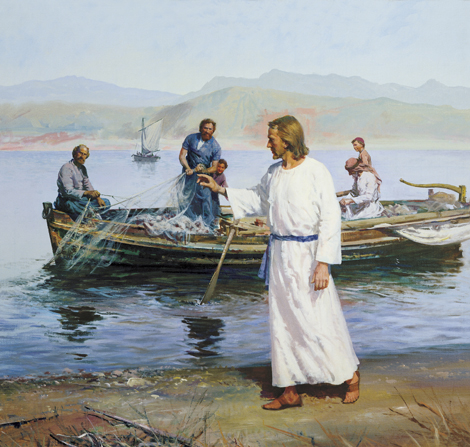
Image result for jesus calls fishermenBecause of seeing His interactions with a few, we can have hope and faith in His dealings with us that are less public and less visible. We trust that we too can receive revelation for our lives and callings, even in our weakness. While there is a temptation to say, "Yes, but that Stephen the martyr, and I'm just Steve" we remember that each of these people were called up onstage not because of anything they had previously done. Moses was an outcast shepherd and Peter a fisherman. There is no limit to what God can do through and make of a pliable and humble heart.
Image result for joseph first vision

One of my favorite teachings of Joseph Smith is this: "God hath not revealed anything to Joseph, but what He will make known unto the Twelve, and even the least Saint may know all things as fast as he is able to bear them, for the day must come when no man need say to his neighbor, Know ye the Lord; for all shall know Him … from the least to the greatest [see Jeremiah 31:34]" (emphasis added).

What blessing and privilege, hope and faith, are ours because of the disproportionate value God bestows on a few publicly!

Friday, August 4, 2017

The importance of one inspired word: residual

In 2002 I was graduating from BYU. It was a great day and for the most part a very happy one. There was only one thing troubling me, a task I had not been able to accomplish. I had worked on it and done my dead-level best to fulfill it, but had not been able to. I worried about it (just a little) that day. Had I done right? Had I really done everything I could? Had I missed something important?

Our graduation speaker was Pres. Henry B. Eyring, an apostle of Jesus Christ. Most of his speech was about the school motto: Enter to Learn, Go Forth to Serve. He emphasized the second part, going forth to serve. It was a nice little graduation speech.

Then in the middle-end of his speech, he used a word that was very significant to me: residual. He told us to do the best we can, and leave the residual in God's hands. In econometrics - the statistics that economists use, and a class I had not only taken but TAd 3 times - the residual is an error term tacked onto the end of an equation for all the things we don't know and can't control.

I suddenly felt the beginnings of understanding a very important principle. Yes, we cannot know all that God has planned or control others' choices. We can only control what we can control. But we can trust God for all that we cannot control, that the end will bring us out alright, that even the greatest trials of our life can be for our experience and benefit. Trust Him for the rest.

That one word and that phrase stuck with me for the last 15 years. How important and what a relief it was to feel that I had done all I could and it was okay to leave the residual in God's hands! I went away comforted and at peace.

I was thinking of that experience again last week for some reason and looked up Pres. Eyring's speech. It turns out he only used the word residual once - enough for me to latch onto it - and otherwise used the term "residue." Maybe my hearing wasn't 20/20 even then and I heard residual because I'd spent so much time thinking about it. Here is what he said after quoting D&C 103:35-40:
Your key and mine to rising to our potential as servants is to know our Master, to do for Him what we can, and be content to leave the residue in His hands. Let me give you an example that will face you in the days ahead. You will be torn between the demands to put bread on the table and a roof over your head, to take care of a family need, to respond to the cries of the widows or the orphans around you, and at the same time to meet the requirements of the calling you have accepted in the Church. When that happens, you will be sorely tempted to murmur, perhaps even to complain. 
But remember that you serve a Master who loves you, who knows you, and who is all-powerful. He has created not demands for your service but opportunities for your growth. You can pray to Him with confidence and ask, “What would you have me do next?” If you listen humbly and with faith, you will feel an answer. And you will, if you are wise and good, set about to do that which your Master has commanded. And you will leave the residue in His hands. As His servant I promise you that you will find that some of those residual tasks you left will be done when you return to them. Others will have been prepared for you. And you will be the stronger for the task you already tackled. 
Then, when you pray again, an answer will come again. And you will move on to the next task, at peace and not complaining. Sometimes you may not feel an answer to your prayer because your Master may not care which task you start next. But He will care that you asked. And whatever you choose to do next, you will know that the residue is in His hands.

Saturday, December 3, 2016

Creating a few good excuses

I wrote this post at least 4 years ago, but never posted it for some reason. I stumbled on it today and thought it deserved sharing.
---------------------------------------------------------------

My brother was teaching the priesthood lesson this week from the Pres. George Albert Smith manual. It was the third or so in a row in being member missionaries. I forget the exact words Steve used, but he and the lesson talk about the fact that you cannot "scold" anyone into Heaven, "but I want to tell you that we can love them into the direction of our Father in heaven..."
When Steve quoted the second great commandment, to love our neighbors as ourselves, it got me thinking. The command is NOT to convert a bunch of people, and therefore love them because it's a useful tactic. The command is to love them, and as a happy result of that you will occasionally get the chance to be of service to them.
--------

We had a few too many visits from a friendly, agreeable, thoughtful plumber this summer. When his work was done, I asked if he had ever been given the opportunity to have a Book of Mormon. He confirmed that he had several LDS friends and he knew it was required in many churches to try to win converts. I wasn't sure how to respond. He didn't sound offended, but I could tell the gesture was not received the way I felt.

He was a nice guy. He had made our lives better working harder than was strictly required. I wanted to thank him with more than money. I wanted to form a friendship in the little time we have in the States, and quite frankly the Church is the primary way I socialize.

He was one of many people whose lives I would like to bless with the thing that has given me the greatest joy. The thing is, most of those people I'm going to see again, so I can comfortably keep putting off that invitation - mostly in the fear that it and I will be rejected and taken in one of many wrong ways. But I cared for someone and wanted to share.

--------

Before we moved to Nigeria, I was an assistant clerk keeping track of membership records and then executive secretary. Among the things I did was track attendance. I didn't feel that was enough. I wanted to know if someone was missing. I not only counted heads, but learned to recognize everyone by the back of their head so I could tell if someone was missing for a few weeks and make sure the proper people had noticed and were taking care of them.

When new people moved in - a frequent occurrence in student areas - I ran over to greet them. This was a very new phenomenon for me. I'd always been content (as music chair or choir director) to find out if someone had musical talents and rush over once someone told me they sang. Now it was my job to get the information of new members so I could request their records into the area. But more than that, I wanted them to feel welcomed and appreciated. I wanted them to stay.

Being membership clerk gave me a script to follow, and that was the support/crutch I needed to be able to get over my awkwardness and try saying hello. Home and visiting teaching is not just a duty to visit once a month, but an opportunity both to come to love and serve someone and to open our homes and hearts to someone we might not otherwise have socialized with. I'm not comfortable in a lot of social interactions, but being a home teacher, a clerk, a choir director, whoever, gives me a role to fill and helps me start reaching out.

Callings and assignments - and even missionary duties - are opportunities to get to know people, to befriend them, to learn even to love them.

They were all excuses. An excuse to love someone.

Thursday, March 6, 2014

What I read in ... the Book of Mormon title page

I love that, no matter how many times we have read the scriptures, there is always more to find and discover. Last night I read the title page to the Book of Mormon and found something new.

The title page was written by a guy named Moroni just before he buried the record for Joseph Smith to find 1400-some-odd years later. Its main job is to tell the reader what they are about to get themselves into: it's written to the house of Israel and the Gentiles so they know that Jesus is the Christ and that He will fulfill the covenants He made with the house of Israel. It also gives the world's briefest synopsis of the Book of Mormon story.

The new thing I saw came before all that. In that all-caps, serif font it says
"THE 
BOOK OF MORMON

AN ACCOUNT WRITTEN BY
THE HAND OF MORMON
UPON PLATES
TAKEN FROM THE PLATES OF NEPHI"

I asked myself: What are the very first things Moroni, probably unconsciously, wants us to know?
1 - This is my dad's book. He wrote it. He physically wrote it with his own hand. I'm not going to take credit for my dad's life work.
2 - He wrote it on plates. The gold is irrelevant. It's just plates. Of course, if you're holding these plates right now, you kind of know that.
3 - Mormon, my dad, used sources. His primary source material came from other plate records we call the plates of Nephi.

In other words: MORMON AND MORONI CITE THEIR SOURCES!!! and that is the first thing they want us to know.

My number one single greatest complaint about the students at AUN is the constant plagiarism to which I am subjected and the neverending headaches and struggle I have trying to convince them that the quote-mark key is not their enemy. Here in the very first words of the Book of Mormon, we see the prophets taking care to cite their sources and give credit where it's due.

It flooded back to me how often Mormon mentions the plates he's working from, explaining that he isn't recording even 1% of it all, adding a whole section just to explain what he's copying and where these other plates came from, mentioning that the words he's about to write came from Alma's very own record, and evaluating the reliability of the sources (now if the guy who kept the records didn't make any mistakes, it was this year....).

I didn't weep, but that was beautiful to me. Mormon and Moroni cite their sources. Just one more reason why I love this book. :)

Thursday, February 20, 2014

A conversation with Hugh Nibley about my answer key

I was writing an answer key for my International Finance class just now. In passing, I mentioned an "Edenic business climate." That's when the imaginary ghost of Hugh Nibley walked into my office and took a seat.

Hugh: That is a contradiction in terms. There is no business in Eden, so there cannot be an Edenic business climate.

DW: Alright, fine. I'll call it idyllic then.

Hugh: Idyllic for Bablyon?

DW: Listen, Hugh, I'm trying to write an answer key here, and I'm not teaching a religion class.

Hugh: Why not? Shouldn't you be preparing them for the real world?

DW: I'm not being paid to teach religion. I'm being paid to teach about that part of the real world that deals with international finance and that means talking about business.

Hugh: 'Business! Mankind was my business. The common welfare was my business: charity, mercy, forbearance, benevolence, were all my business. The dealings of [international finance] were but a drop of water in the comprehensive ocean of my business!' Do your idyllic business conditions improve those?

DW: Thank you, Charles Dickens. Look, I do the best I can to bring ethics into my teaching. I have students consider the impact of these policies on the poor; I continually challenge them to "rove beyond the narrow limits of their money changing holes" to serve their fellow Nigerians; every semester at least one class gets to see me tearing money into shreds to convince them that money is not the point and never has been; according to their answers on the midterm, I seem to have convinced my principles of macro students that their businesses will be best served by paying their workers more; 

Hugh: Which you weren't trying to do...

DW: I'll take it anyway. I gave a mini-lecture just last week on Christian and Islamic finance. I do what I can. It's hard being an economist and a preacher at the same time.

Hugh: You mean it's hard to have one foot in Babylon and one in Zion at the same time? Some day you're going to have to choose.

DW: That's not a fair description of me and you know it.

Well, either he gave in at that point or else I had successfully fought against the light long enough to go back to the darkness of mere economics. 

And idyllic business climates.